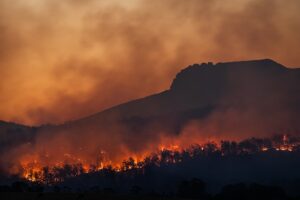
The arrest of a 37-year-old man suspected of intentionally igniting one of the devastating wildfires currently ravaging the Spokane region marks a grim turning point in a crisis that has already redefined the scale of disaster management in the Pacific Northwest. As smoke blankets the skyline and thousands remain displaced, this criminal element adds a layer of volatility to an already precarious situation, transforming a natural catastrophe into a complex forensic and legal battlefield.
The Scale of the Spokane Crisis
What began as a series of localized ignitions has escalated into one of the most destructive wildfire seasons in Washington state history. Current data indicates that the fires have already destroyed at least 700 structures, leaving a trail of devastation across the Spokane area. The human cost is equally staggering, with approximately 67,000 people forced to evacuate their homes, effectively displacing nearly a quarter of the city’s residents in some sectors.
The Spokane County Sheriff’s Office confirmed the arrest of the suspect in connection with one of the three primary blazes currently threatening the region. While the investigation into the exact ignition point and the suspect’s motive is ongoing, the timing of the arrest is critical. The fires are not merely a seasonal occurrence; they are part of a broader pattern of extreme weather events that have placed immense strain on regional infrastructure and emergency response capabilities.
The Intersection of Criminal Intent and Climate Volatility
The presence of arson in a season already defined by extreme drought and high winds creates a unique institutional challenge. When wildfire activity is driven by human malice rather than lightning or accidental utility failure, the legal and policy implications shift dramatically. For local law enforcement, the priority is immediate containment, but for the judicial system, this incident introduces a high-stakes prosecution that will likely serve as a test case for how states handle intentional acts that result in mass displacement and massive economic loss.
From a policy perspective, this incident complicates the narrative surrounding wildfire management. For years, the debate has been polarized between those focusing on forest management and fuel reduction and those pointing toward broader climatic shifts. The introduction of arson into this equation complicates the ability of state and federal agencies to predict fire behavior. If a significant percentage of ignitions are determined to be human-caused, it necessitates a massive shift in funding from purely ecological management toward increased surveillance and law enforcement resources within national and state forests.
Furthermore, the economic ramifications are profound. The destruction of 700 structures represents a massive hit to the local real estate market and insurance industry. As claims surge, we are likely to see a tightening of insurance availability in high-risk zones, a trend that has been accelerating across the Western United States. The Spokane fires are not just an environmental disaster; they are a systemic shock to the regional economy that will be felt in tax revenues, housing availability, and municipal budgets for years to come.
Historical Precedents and Institutional Friction
This crisis unfolds against a backdrop of intense political scrutiny regarding federal land management. Under the current administration of President Donald Trump, the debate over the role of the Bureau of Land Management (BLM) and the U.S. Forest Service has remained a central point of contention. The Trump administration’s approach to deregulation and resource extraction often clashes with the conservation-heavy mandates of federal agencies, creating a friction point when large-scale disasters occur on federal lands.
Historically, large-scale arson events during extreme weather seasons have led to significant shifts in how the National Interagency Fire Center (NIFC) coordinates with state authorities. We saw similar patterns during the historic fire seasons of the early 2000s, where the sheer volume of ignitions overwhelmed state-level resources, forcing a reliance on federal military assets for evacuation support. The Spokane incident is likely to trigger a similar demand for inter-agency coordination, testing the limits of the existing mutual aid agreements between Washington state and the federal government.
What to Watch: The Legal and Policy Fallout
As the legal proceedings against the suspect move forward, several key indicators will emerge that will shape future wildfire policy. First, watch the prosecution’s strategy. If the state pursues enhanced sentencing due to the scale of the displacement and property loss, it could set a precedent for treating arson-driven wildfires as acts of domestic terrorism or mass-casualty crimes, rather than standard arson cases.
Second, monitor the federal response. As the fires continue to burn, the pressure on President Trump to declare a major federal disaster for the region will mount. The interplay between state-level emergency declarations and federal FEMA assistance will be critical in determining how quickly recovery efforts can begin. We are entering an era where the distinction between ‘natural disaster’ and ‘human-caused catastrophe’ is increasingly blurred, requiring a more integrated approach to emergency management and criminal investigation.
Key Takeaway
The Spokane wildfires represent a convergence of environmental volatility and criminal intent that threatens to overwhelm existing disaster-response frameworks. The arrest of an arson suspect amidst such massive structural and human displacement transforms a localized emergency into a national case study on the legal, economic, and political complexities of modern wildfire management.