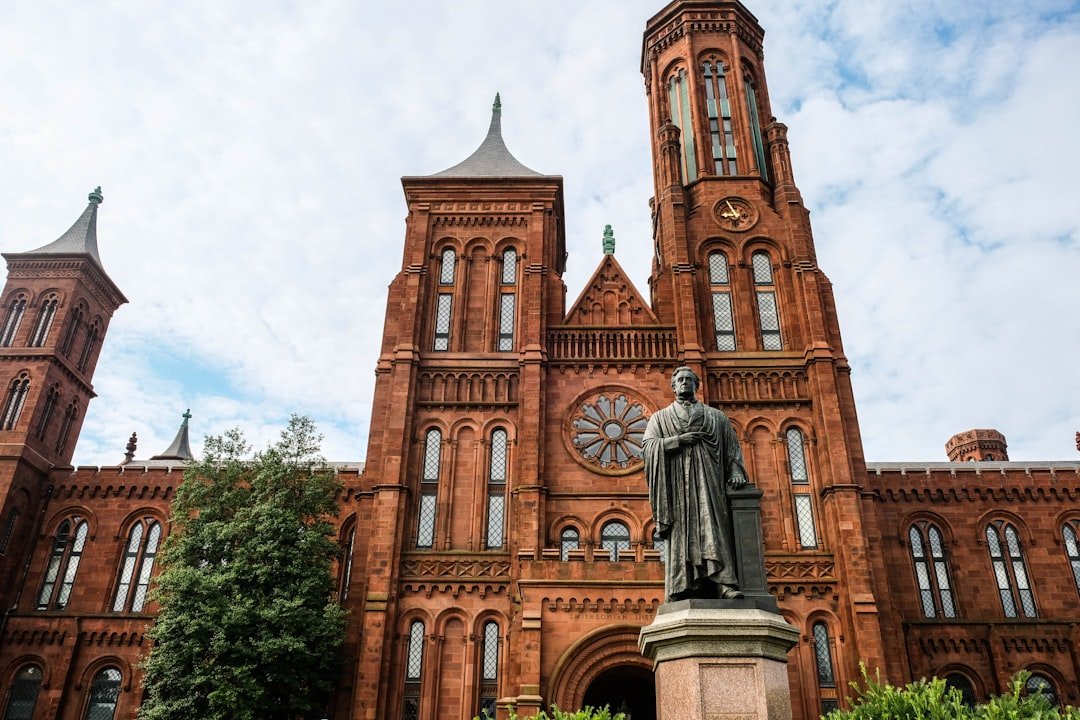
President Donald Trump’s late-Friday social media directive to the Smithsonian Institution — demanding an 11-foot George Washington statue in the Flag Hall by Constitution Day and a five-year exhibit running through Washington’s 300th birthday in 2032 — is not merely a ceremonial request. It is a calculated assertion of executive influence over the nation’s primary historical steward, arriving at the precise moment the federal government is organizing the largest commemoration in a generation.
What Happened
In posts on Truth Social and X on September 11, President Trump called on the Smithsonian to “honor the Father of Our Country” by installing the statue featured at the Freedom 250 IndyCar race at Indianapolis Motor Speedway in August — a event organized by the U.S. Semiquincentennial Commission — and launching an exhibit beginning immediately and continuing through February 22, 2032. The White House followed with a formal letter to Smithsonian Secretary Lonnie Bunch III, framing the request as a presidential priority for Constitution Day, September 17.
The Smithsonian has not publicly committed to the timeline. A spokesperson stated the institution “welcomes input from all stakeholders” but emphasized that exhibition planning follows “established scholarly review processes” governed by the Board of Regents. The statue in question, a bronze by sculptor David Alan Clark, was commissioned for the IndyCar event by the Semiquincentennial Commission, not the Smithsonian. Its permanent placement would require deaccession review, conservation assessment, and Regents approval — a process that typically spans 18 to 24 months.
Why It Matters
The request exposes a structural tension: the Smithsonian is a trust instrumentality of the United States, created by Congress in 1846 and governed by a 17-member Board of Regents that includes the Chief Justice, the Vice President, three Senators, three Representatives, and nine citizen appointees. The President is not a Regent and holds no statutory authority over exhibition content. Yet every modern president has tested those boundaries. President Nixon pressured the National Portrait Gallery to remove a controversial portrait of himself in 1973. The Reagan administration attempted to redirect the National Museum of American History’s “A More Perfect Union” exhibit on Japanese internment in 1987. Both efforts failed after congressional and scholarly pushback.
This time, the stakes are amplified by the Semiquincentennial — the 250th anniversary of the Declaration of Independence in 2026. The U.S. Semiquincentennial Commission, established by Congress in 2016 (P.L. 114-196), is chaired by the President’s designee and includes eight congressional appointees and 16 private citizens. Its budget request for FY2026 exceeds $50 million. The Commission’s “America 250” branding has already appeared on IndyCar livery, Postal Service stamps, and now a presidential directive. The Smithsonian, as the designated lead cultural partner, sits at the center of a commemoration that will define how a polarized nation remembers its founding.
Trump’s specificity — Constitution Day, the Flag Hall, the 2032 endpoint — signals an intent to lock in a narrative framework before the 2026 midterms and the 2028 presidential cycle. The Flag Hall, home to the Star-Spangled Banner, is the museum’s most visited and symbolically charged space. Placing a Washington statue there permanently would anchor the commemoration’s iconography in a specific vision of founding-era reverence, one that aligns with the President’s frequent invocation of “1776” as a counter to the 1619 Project and critical race theory debates.
Historical Context
The Smithsonian has navigated presidential pressure before. In 1995, the Enola Gay exhibit at the National Air and Space Museum became a flashpoint when veterans’ groups and Congress objected to its framing of the atomic bombings. The Smithsonian revised the exhibit under intense political pressure, a decision that still haunts its institutional memory. In 2003, the National Museum of American History postponed an exhibit on the internment of Japanese Americans after the Department of Justice raised objections — a rare instance of executive branch interference in curatorial judgment.
Congress has occasionally reinforced the Smithsonian’s independence. The 1980 “Smithsonian Institution Independence Act” clarified that the Regents hold “full power and authority” over collections and exhibitions. But the institution’s federal funding — approximately 62% of its $1.5 billion annual budget comes from congressional appropriations — creates persistent leverage. The FY2026 appropriations cycle, currently underway, includes $1.1 billion for the Smithsonian. Committee report language often signals congressional priorities for specific museums or exhibits.
The Washington statue request also intersects with the ongoing debate over commemorative landscapes. Since 2020, more than 160 Confederate monuments have been removed nationwide, while disputes over Founding Father memorials have intensified. The Smithsonian’s own “Reckoning with Our Racial Past” initiative, launched in 2021 with $25 million from Bank of America, has funded research into the Institution’s historical ties to slavery and scientific racism. A presidential mandate for a traditional Washington monument, absent contextual framing, could be read as a repudiation of that work.
What to Watch
Three developments will determine whether this directive reshapes the Institution or becomes another footnote in executive overreach. First, the Board of Regents’ September 22 meeting — its first since the request — will reveal whether citizen Regents, including several appointed by President Biden, push back on procedural grounds. Second, the House Administration Committee, chaired by Rep. Bryan Steil (R-WI), has oversight jurisdiction and has already signaled interest in “ensuring the Semiquincentennial reflects American greatness.” Its FY2027 authorization bill could embed the statue requirement in law. Third, Secretary Bunch’s response. A historian of African American history and the first Black Secretary, Bunch has navigated political pressure by emphasizing “scholarly rigor” and “community engagement.” His decision on whether to fast-track the statue — or refer it to the standard curatorial pipeline — will set a precedent for the next four years.
Also watch the Semiquincentennial Commission’s next public meeting in October. Its executive director, Daniel M. DiLella, a Trump appointee, has privately advocated for “signature projects” that transcend partisan divides. The Washington statue may be the first of several presidential “asks” framed as Commission priorities.
Key Takeaway
The statue is a proxy battle. The real contest is whether the Smithsonian can maintain its congressionally designed independence as the federal government spends the next six years defining what the 250th anniversary means — and who gets to author that definition. If the Institution accommodates a presidential directive on an accelerated timeline without its standard scholarly review, it signals that the Semiquincentennial will be curated from the White House, not the Regents’ room. That would mark a fundamental shift in how the nation’s attic operates: from a trust for the diffusion of knowledge to a stage for the diffusion of power.