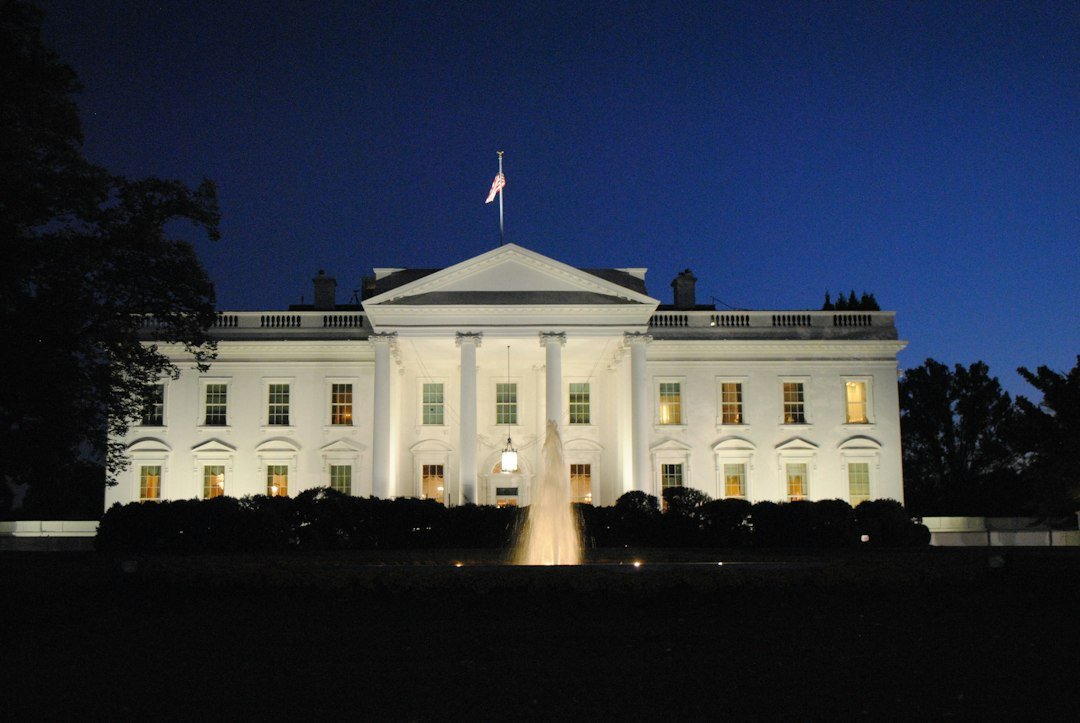
The B-1 bomber flyover was the loudest signal of the evening, but the guest list told the more consequential story. When President Donald Trump welcomed President Xi Jinping to the White House on September 24, the 100-foot red carpet and 21-person honor guard performed the traditional theater of great-power diplomacy. Yet the presence of roughly two dozen technology executives — including leaders from Nvidia, Microsoft, Apple, and OpenAI — revealed a diplomatic subtext that no menu of Chilean sea bass and honey ice cream could obscure: the architecture of US-China technological competition is being renegotiated in real time, and the corporations caught in the crossfire are demanding a seat at the table.
The Guest List as Policy Signal
State dinners are never merely social affairs. The seating chart functions as a hierarchical map of presidential priorities. In 2011, President Obama seated then-Vice President Biden next to Xi — then China’s vice president — signaling the administration’s investment in a personal relationship that would later fray. In 2019, Trump’s first-term state dinner for Xi at Mar-a-Lago featured few tech leaders, reflecting an era when tariffs were the primary instrument of pressure.
Thursday’s roster was different. According to White House pool reports confirmed by multiple attendees, the tech contingent included Jensen Huang of Nvidia, Satya Nadella of Microsoft, Tim Cook of Apple, and Sam Altman of OpenAI — collectively representing over $8 trillion in market capitalization. Their presence was not ceremonial. Each leads a company navigating the Biden-era export controls on advanced semiconductors and AI chips that the Trump administration has not only maintained but in some cases tightened. Nvidia’s H20 chip, designed specifically to comply with US restrictions for the Chinese market, now faces potential further limits. Microsoft and Apple rely on Chinese manufacturing and consumer markets. OpenAI has no formal presence in China but competes with Chinese AI labs racing toward parity.
Transaction Over Ideology
If there was a unifying theme to the evening, it was transactional pragmatism. President Trump has consistently viewed alliances and adversaries through the lens of deal-making, and the tech CEOs present have spent the past eighteen months mastering the art of the White House visit. Since January 2025, Huang has visited the White House at least four times. Cook has made the pilgrimage three times. Altman appeared alongside the president for the Stargate infrastructure announcement in January. These are not courtesy calls; they are lobbying by other means.
The administration’s willingness to host them alongside Xi sends a dual message. To Beijing: American technological dominance remains intact, and the companies driving it have presidential access. To the tech sector: the White House understands your China exposure, but compliance with national security directives is non-negotiable. The tension is irreducible. Nvidia’s China revenue dropped from $5.8 billion in the quarter before the October 2023 controls to roughly $2.1 billion by early 2025, according to SEC filings. Yet Huang has publicly argued that over-restriction accelerates Chinese indigenous innovation — a view shared by significant portions of the national security establishment.
Historical Echoes, New Constraints
Veterans of the Kissinger-Nixon opening to China will recognize the choreography: the children with flowers, the honor guard, the emphasis on personal chemistry between leaders. But the structural constraints are fundamentally different. In 1972, the US and China shared a strategic interest in countering the Soviet Union. Today, they are each other’s primary strategic competitor. The technology domain — semiconductors, artificial intelligence, quantum computing, biotechnology — is the central arena of that competition.
The Obama administration’s 2015 state dinner for Xi produced the landmark cyber agreement in which China pledged not to conduct commercial espionage. That agreement collapsed within years. The Trump administration’s Phase One trade deal in 2020 similarly unraveled. Thursday’s dinner produced no signed agreements, no joint statements on AI safety, no breakthrough on fentanyl precursor cooperation — the three issues where White House aides had signaled potential progress in background briefings. The absence of deliverables is itself a data point: the trust deficit is too deep for ceremonial diplomacy to bridge.
What the Menu Didn’t Show
The first course — yellow squash velouté with wild mushrooms, crispy pancetta, and scallion oil — blended American and Chinese culinary traditions in a way the bilateral relationship no longer does. The main course of Chilean sea bass with bok choy and fermented black bean sauce similarly fused traditions. But the dessert — honey ice cream with salted caramel and almond tuile — was purely American. The symbolism was likely unintentional but apt: the integration that once characterized the relationship has given way to a managed separation where each side retains what it values and discards the rest.
Notably absent from the guest list were representatives from the semiconductor equipment companies — ASML, Applied Materials, Lam Research — whose export licenses the administration has restricted. Also missing: the bipartisan congressional China hawks who have driven the legislative framework of competition, from the CHIPS Act to the recent Outbound Investment Transparency Act. Their absence suggests the dinner was designed for a specific audience: the corporate leaders who must implement policy, not the legislators who write it.
What to Watch
Three indicators will reveal whether Thursday’s pageantry translates into policy shift. First, watch the Entity List. The Bureau of Industry and Security’s quarterly updates have added Chinese AI and semiconductor entities at an accelerating pace — 42 additions in the first half of 2026 alone. A pause or slowdown would signal a tactical opening. Second, monitor the “validated end-user” authorizations that allow limited shipments to pre-approved Chinese firms. Nvidia’s H20 and Intel’s Gaudi 2 China-specific chips operate under these licenses. Expansion of the VEU program would indicate practical engagement. Third, track the Treasury Department’s outbound investment rules, finalized in August 2025, which require US persons to notify or obtain permission for certain AI and quantum investments in China. The first compliance reports are due in November 2026; the pattern of approvals and denials will show whether the administration is tightening or calibrating.
Meanwhile, the tech CEOs return to a changed landscape. The House Select Committee on the Chinese Communist Party has scheduled hearings for October on “AI Diffusion and Strategic Competition” — a clear signal that congressional oversight of tech-China engagement is intensifying. The companies at Thursday’s dinner will need to navigate not just presidential preference but legislative mandate.
Key Takeaway
The state dinner’s most revealing moment came not during the toasts but in the receiving line beforehand, where President Trump greeted each tech CEO by name while Xi and his delegation observed. The visual was unmistakable: the American president signaling to his Chinese counterpart that the architects of US technological power answer to Washington, not Beijing. But the reverse signal was equally clear — those same architects cannot sustain their business models without Chinese markets, supply chains, and talent. The dinner did not resolve this contradiction. It merely displayed it, in white tie and bomber flyovers, for a world where the technology cold war has replaced the nuclear one as the defining strategic fact.