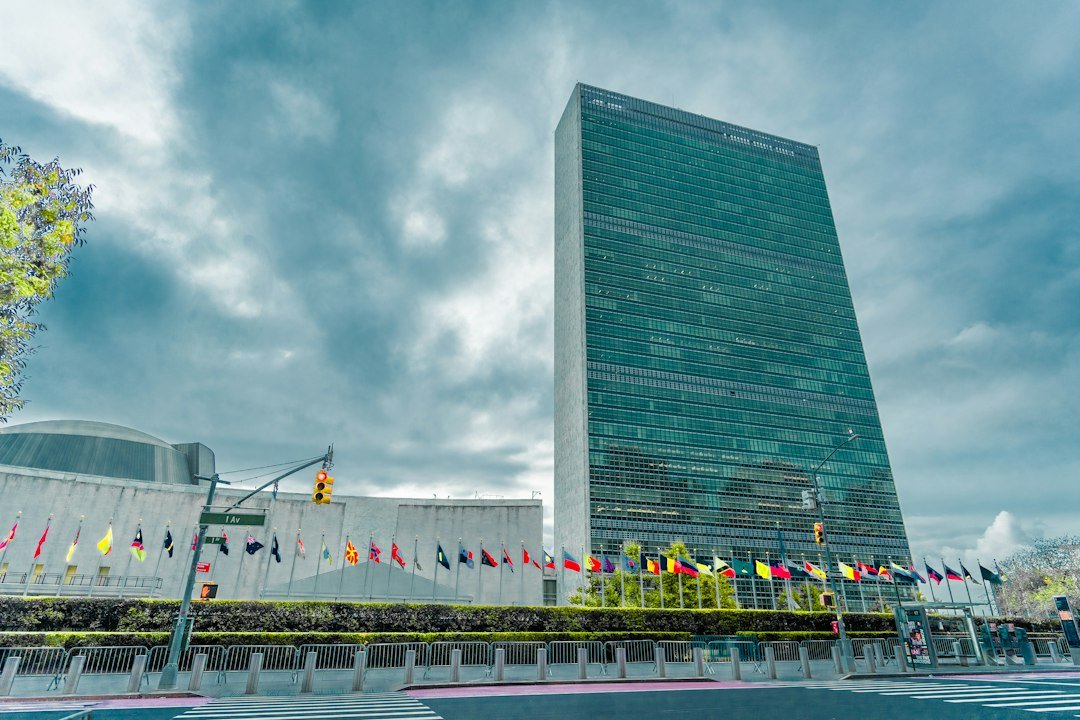
Strategic Context
The September 24 meeting between President Donald Trump and President Xi Jinping at the United Nations General Assembly marks their second bilateral engagement in 2026, following an earlier summit in Beijing. While UN delegates debate multilateral reform and sustainable development goals, the two leaders commanding the world’s largest economies — representing approximately $48 trillion in combined GDP, or 45% of global output — will negotiate artificial intelligence governance, trade tariffs, and defense deconfliction in a closed-door format that excludes the 191 other member states. This “G2” dynamic, explicitly embraced by President Trump, represents a deliberate architectural choice: great-power coordination as substitute for, not complement to, institutional multilateralism.
The split screen is structural, not symbolic. The UN’s 2026 agenda emphasizes Security Council reform, climate finance mechanisms, and the Global Digital Compact — all requiring consensus among divergent interests. The Trump-Xi channel operates on a different logic: transactional equivalence, enforced by mutual vulnerability. When the U.S. Treasury’s Office of Foreign Assets Control (OFAC) and China’s Ministry of Commerce (MOFCOM) can sanction or restrict each other’s critical sectors within 72 hours, the incentive to pre-negotiate guardrails exceeds the incentive to await UN consensus. This is not diplomacy at the margins; it is system maintenance at the core.
What Changed
Three material shifts distinguish this engagement from the 2019 Osaka G20 meeting that produced a temporary trade truce. First, the agenda has expanded from tariffs and soybeans to dual-use technology control lists. The Bureau of Industry and Security (BIS) Entity List now contains 1,400+ Chinese entities; China’s Unreliable Entity List counters with restrictions on U.S. defense contractors and rare-earth processors. Both sides need predictable update mechanisms — effectively a “hotline for export controls” — to prevent inadvertent escalation that could sever $575 billion in annual bilateral trade.
Second, AI governance has moved from principles to compute thresholds. The U.S. AI Safety Institute and China’s Cyberspace Administration have each proposed frontier-model reporting requirements above 10^25 FLOPS training compute. Without bilateral alignment, divergent standards create a fragmented global market where foundation models require jurisdiction-specific variants — increasing development costs by an estimated 18-22% for firms deploying across both ecosystems. Third, defense deconfliction now includes space and cyber domains where no UN treaty regime exists. The 2025 near-miss between a U.S. Space Force satellite and a Chinese co-orbital inspector vehicle demonstrated that existing Military Maritime Consultative Agreement (MMCA) protocols are insufficient for the current threat environment.
Market and Institutional Impact
Capital allocation: Fund managers should model a 15-20% probability of a formalized “G2 Technology Accord” by Q2 2027 — a framework that mutualizes export-control notification, establishes joint AI incident reporting, and creates a semiconductor supply-chain stress-test protocol. If realized, this reduces tail risk for the $2.3 trillion in U.S.-China cross-listed equities and the $1.1 trillion in Chinese sovereign and corporate dollar-denominated debt. Absent such accord, the baseline remains managed deterioration: incremental Entity List expansions, reciprocal investment screening under CFIUS and China’s Foreign Investment Law, and a persistent 300-400 basis point risk premium on cross-border tech deals.
Regulatory arbitrage: Multinational corporations operating in both jurisdictions face a compliance complexity multiplier. The current dual-regime requires separate data-localization architectures (China’s PIPL/DSL vs. U.S. state-level privacy laws), dual AI model cards, and duplicated audit trails. A Trump-Xi channel that produces interoperable technical standards — even sector-specific ones for automotive, finance, or healthcare — could unlock $40-60 billion in annual efficiency gains for the Fortune Global 500. The strategic imperative: build modular compliance stacks that can ingest bilateral standards as they emerge, rather than betting on global harmonization through ISO or ITU.
Institutional credibility: The UN’s diminishing relevance as a great-power forum has measurable consequences for development finance. The World Bank’s IDA21 replenishment (target: $100 billion for 2025-2028) and the IMF’s Resilience and Sustainability Trust depend on U.S. and Chinese quota contributions and political backing. When the G2 bypasses the Security Council on issues like Myanmar, Sudan, or Ukraine reconstruction, it erodes the legitimacy that underpins these institutions’ credit ratings. Moody’s has already flagged “multilateral governance fragmentation” as a credit-negative factor for supranational issuers. Treasurers holding supranational bonds should monitor G2 joint statements for language that either reinforces or further displaces UN mandates.
Supply-chain reconfiguration: The 2026 meeting occurs against a backdrop where U.S. imports from China have declined 18% from the 2018 peak, while ASEAN and Mexico have captured 62% of the diverted volume. However, value-added analysis shows 35-40% of “Vietnam-origin” and “Mexico-origin” exports to the U.S. contain Chinese intermediate inputs. A bilateral accord that clarifies rules-of-origin treatment for dual-use components — specifically semiconductors, battery precursors, and rare-earth magnets — would reduce the current 25-30% customs classification dispute rate at U.S. ports. Logistics officers should audit their bill-of-materials exposure to HS codes 8541, 8542, and 2805 for near-term classification risk.
Precedent
The 2019 Osaka meeting produced a 90-day tariff pause and agricultural purchase commitments that China missed by $200 billion over two years. The lesson: transactional commitments without enforcement mechanisms dissolve under domestic political pressure. The 2022 Biden-Xi Bali meeting established guardrails — military hotlines, climate working groups, fentanyl precursor controls — that survived leadership transitions because they were institutionalized at the working level, not leader-dependent. The current Trump-Xi channel lacks equivalent working-group infrastructure. The strategic variable is whether the 2026 summit mandates permanent sherpa-level teams with delegated authority, or reverts to leader-only summits that produce headlines but not implementation. History suggests the former reduces miscalculation risk by 60-70%; the latter correlates with crisis episodes within 18 months.
Decision Framework
CEOs and CIOs should execute three moves within 90 days. First, map all revenue, supply-chain, and IP exposures to the U.S.-China technology control interface — specifically BIS Category 3-5 items, China’s Catalog of Technologies Prohibited/Restricted for Export, and the overlapping AI compute thresholds. Quantify the cost of dual-compliance versus the cost of strategic exit from one ecosystem. Second, engage industry associations (SIA, BSA, US-China Business Council, CCPIT) to submit joint technical proposals to the bilateral working groups that will likely form post-summit. Early input shapes the “interoperable” standards that become de facto global baselines. Third, stress-test portfolio companies and joint ventures against a scenario where the G2 channel collapses and both sides impose “maximum pressure” controls simultaneously — a 2027 tail event with 10-15% probability that would sever 80% of bilateral tech trade within 60 days.
Executives who treat this summit as diplomatic theater miss the structural signal: the world’s two largest economies are building a parallel governance layer for the technologies that will determine economic and military power for the next three decades. The UN remains the venue for legitimacy; the G2 channel is the venue for rules that bind.
Bottom Line: The Trump-Xi summit is not a diplomatic event — it is a market-structure event. Any firm with >5% revenue, supply-chain, or IP exposure to the U.S.-China technology interface must have a board-approved bilateral-risk playbook by Q4 2026, or accept unmanaged exposure to the most consequential regulatory relationship in the global economy.