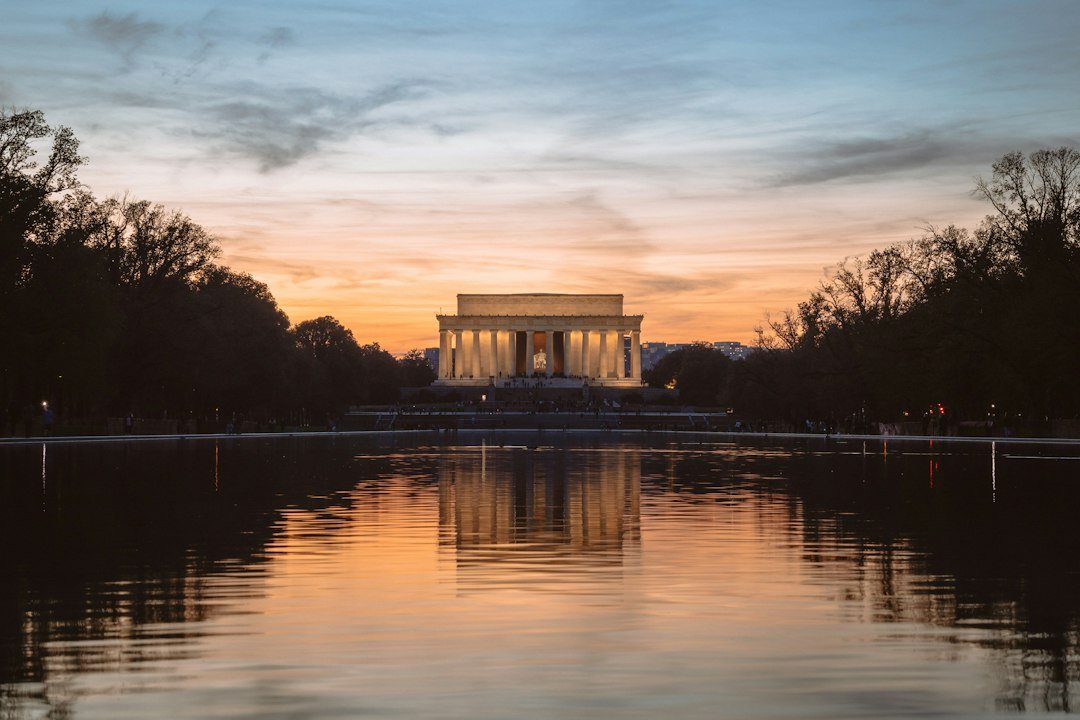
President Donald Trump stood at the edge of the Lincoln Memorial Reflecting Pool on Monday afternoon, holding up laminated photographs of green-tinged water like a homeowner showing off a kitchen remodel. The images — “before” and “after” shots of a $25 million renovation project completed last spring — were the centerpiece of his final public address before Tuesday’s midterm elections. No new policy announcements. No direct appeals to the 35 Senate seats or 36 gubernatorial races on the ballot. Just a president, a podium, and a reflecting pool scrubbed clean of algae.
The visual was unmistakable: the 47th president, framed by the temple to the 16th, touting cosmetic infrastructure as his closing argument. But the deeper story isn’t about the pool. It’s about what the pool represents — a presidency that has mastered the grammar of symbolic politics while struggling to translate that fluency into legislative majorities or durable coalition-building.
What Happened
The event, billed by the White House as the president’s “closing midterm pitch,” drew a few hundred supporters to the National Mall under overcast skies. Trump spoke for roughly 45 minutes, devoting the opening 15 to the Reflecting Pool renovation — a project authorized and funded during the previous administration but completed under his watch. He held up the photographs at least four times, according to pool reports, describing the “disgusting green slime” he claimed to have inherited and the “crystal clear” water that now mirrors the Lincoln statue.
“We fixed it. We fixed it fast. We fixed it beautiful,” Trump said, pivoting from the pool to a familiar litany of grievances: the “fake news” media, the “corrupt” Justice Department, the “stolen” 2020 election. The renovations, he argued, were a metaphor for his entire presidency: “We’re cleaning up the mess. We’re making it beautiful again.” The speech contained no specific mention of Republican candidates in competitive races — not Senator Jon Tester in Montana, not Governor Josh Shapiro’s successor in Pennsylvania, not the House incumbents defending districts Biden won in 2024.
Why It Matters
The Reflecting Pool stunt crystallizes three strategic realities facing Republicans 24 hours before polls open.
First, the nationalization trap. Midterms are traditionally referendums on the party in power. With Republicans holding a razor-thin 218-214 House majority (plus one Independent) and a 53-47 Senate edge, the GOP’s path to retention runs through districts and states where Trump’s personal brand is a liability, not an asset. The 18 House Republicans sitting in Biden-won districts needed a closing message about inflation, border security, or energy costs — not a presidential photo op at a monument. By making the final news cycle about himself and a reflecting pool, Trump may have crowded out the localized arguments his candidates depend on.
Second, the substance vacuum. The $25 million renovation — funded through the Great American Outdoors Act, a bipartisan 2020 law — is a genuine accomplishment. But it’s also the kind of routine infrastructure maintenance that presidents typically mention in passing, not centerpiece material for a midterm eve address. The elevation of algae removal to signature achievement status suggests a White House lacking legislative victories to showcase. No major bills have cleared both chambers since the spring continuing resolution. The tax extension package stalled in the Senate. The border funding bill died in conference. In the absence of policy trophies, the pool becomes the trophy.
Third, the institutional signaling. Choosing the Lincoln Memorial — rather than a rally in Michigan, a town hall in Wisconsin, or a factory floor in Ohio — tells a story about how this White House views power. Lincoln preserved the Union. Trump used his monument to talk about water clarity. The contrast isn’t merely rhetorical; it reflects a presidency that treats democratic institutions as stages rather than constraints. This matters because the same president who held up pool photos on Monday has spent months suggesting he may not accept election results that don’t favor his party. Election officials in at least six swing states have activated emergency protocols for potential voting-day disruptions, per a CNN review of state contingency plans.
Historical Context
Presidents using monuments as political backdrops is hardly new. Ronald Reagan launched his 1984 reelection at the Statue of Liberty. Bill Clinton spoke at Independence Hall in 1996. Barack Obama chose the Lincoln Memorial for his 2009 inauguration eve concert. But each of those moments tied the setting to a thematic argument about American renewal, bipartisanship, or democratic inheritance. Trump’s Reflecting Pool address had no such connective tissue. The pool wasn’t a metaphor for national healing; it was a metaphor for his personal efficacy.
A closer parallel might be Richard Nixon’s 1970 “silent majority” speech at the Lincoln Memorial — delivered at 4 a.m. to a handful of student protesters, a performative gesture that revealed more about the president’s psychology than his politics. Or consider Herbert Hoover’s 1932 campaign finale at Madison Square Garden, where he touted “prosperity is just around the corner” as the Depression deepened. In both cases, the spectacle substituted for a governing record the president couldn’t defend.
The midterm math is unforgiving. Since 1934, the president’s party has lost House seats in 19 of 23 midterms, averaging a 28-seat loss. The Senate map this cycle favors Republicans structurally — Democrats defend 23 of 35 contested seats — but the GOP’s 53-seat majority is inflated by favorable 2024 coattails. A net loss of four seats would flip the chamber. Trump’s approval rating sits at 43% in the RealClearPolitics average, roughly where Obama (44%) and Clinton (45%) stood before their parties lost 63 and 54 House seats respectively.
What to Watch
Tuesday night’s early returns from Virginia’s 7th District and New York’s 17th District will test whether Trump’s symbolic closing message depressed Republican turnout in suburban seats. Both districts voted for Biden in 2024 but elected Republicans in 2022; their incumbents, Eugene Vindman and Mike Lawler, have explicitly distanced themselves from the president in closing ads. If they survive, it validates the “localize or lose” theory. If they fall, it suggests the national environment — and Trump’s gravity — was decisive.
Post-election rhetoric. If Republicans lose the House, watch whether Trump claims the Reflecting Pool renovation as evidence of a “stolen” mandate — the same logic he applied to crowd sizes in 2017 and vote counts in 2020. The pool photos, brandished as proof of competence, could become exhibits in a grievance narrative. Several Trump allies have already previewed this frame: “We fixed the pool, they stole the election” appeared on Truth Social within hours of Monday’s speech.
Lame-duck dynamics. A divided government outcome — likely if Democrats take the House — would force Trump into his first genuine negotiation with a hostile chamber. The debt ceiling expires in March. Government funding runs out in December. The Reflecting Pool renovation was a unilateral executive action; governing requires consent. The president’s choice to end the campaign on a unilateral achievement may foreshadow a governing style that resists the compromise a divided Congress demands.
Key Takeaway
The Reflecting Pool address wasn’t a campaign event — it was a confession. A president with a legislative record to run on doesn’t hold up algae photos at the Lincoln Memorial on the eve of a midterm. A party confident in its message doesn’t let its leader make the final news cycle about himself. The pool is clean, the water clear, and the reflection staring back at Republicans tomorrow is a referendum they didn’t prepare for.