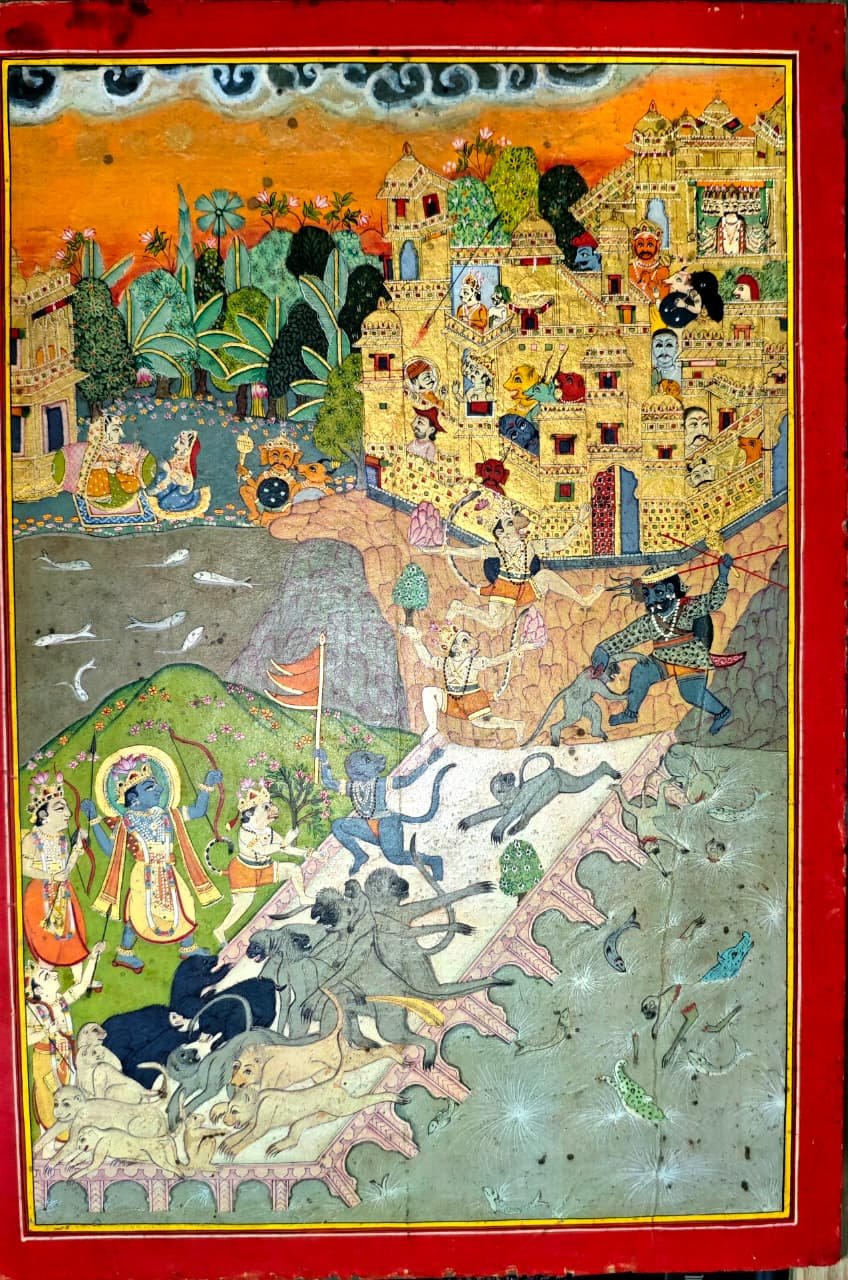
Few episodes in Indian painting carry the charge of the Lanka Kanda—the Siege of Lanka, the sixth book of the Ramayana, in which Rama, Lakshmana and the vanara host cross the causeway of stones to Ravana’s golden citadel. It is a subject built for the miniaturist: an army in motion, a bridge under construction, a fortress waiting across the water, and a moral reckoning about to begin. Rendered small, on a single leaf of paper, it becomes a whole war held in the palm of the hand.
A folio of exactly this subject—from a former princely collection, roughly 22 by 32 centimetres, opaque watercolour heightened with gold—offers a useful window into how the courts of Rajasthan told long stories in a small frame. The composition is continuous narrative: instead of freezing one instant, the painter lets the eye travel across several moments of the same episode within one border. The vanaras heave stones into the sea; the bridge advances; Rama and Lakshmana stand at its head; Lanka rises in gold on the far side. Time moves left to right and back again, the way a reciter moves through the verses. A red border and fine yellow rules close the scene, and the verso carries an old register in a Marwari hand—the kind of working inscription that once helped a court library keep its folios in order.
The Hadaoti hand
On trade opinion the leaf sits within the Kota—or more broadly Hadaoti—tradition, the school that flowered in the small Rajput states of southeastern Rajasthan across the first half of the eighteenth century, roughly 1700 to 1760. Kota painting is best known to collectors for its electric hunting scenes, but the same workshops brought a distinctive energy to devotional narrative: dense, animated crowds, a love of landscape that presses in from the edges, and figures drawn with a nervous, springing line. Where the Mughal atelier prized stillness and finish, the Hadaoti painter prized movement. A Lanka Kanda is the ideal test of that temperament, and the tradition rose to it repeatedly.
Attribution in this field is rarely a matter of a signature. Court painters seldom signed, workshops shared conventions across generations, and folios travelled between collections and were re-margined and re-inscribed along the way. Responsible cataloguing therefore speaks in the language of “attributed to,” “school of,” and “circle of,” and treats period and place as questions for specialists rather than settled facts. The prudent reading of any single leaf is an invitation to scholarship, not a verdict.
What the market pays, and why
The market for Rajput and Pahari miniatures is wide, and it is driven far more by attribution and provenance than by subject. Writing in Mint in 2008, the reporter Tara Kilachand cited Christie’s specialist Hugo Weihe to the effect that miniatures are, by and large, affordable, usually falling within a $5,000–50,000 range. Nearly two decades on, that everyday band still describes most leaves that change hands: an anonymous folio without firm attribution or exhibition history typically sits within it, with condition doing much of the rest.
The picture changes utterly when a leaf can be tied to a named hand, a securely dated series, or a distinguished collection. The same Mint feature noted a Nainsukh of Guler—a Pahari master—that sold at Christie’s for $2.22 million, a record at the time, precisely because “artist attribution helped increase its value.” And in October 2025, at Christie’s London sale of the collection of Prince and Princess Sadruddin Aga Khan, the ladder’s top rungs were on open display.
Estimate, hammer, and the gap between
Three results from that field, set side by side, show how far apart the rungs sit—and what closes the distance.
Christie’s London, October 2025 — realised £10,245,000, some fourteen times its pre-sale estimate; a world auction record for a classical Indian painting.
Christie’s London, October 2025 — realised £5,052,000. A signed, published, court-documented Kota work by a named master.
The lesson is not that the gap between estimate and hammer can be spectacular—though, as Basawan’s cheetahs show, it can be. It is what opens the gap. A fourteen-fold result is not a property of the subject, the age, or the school; it is the product of a secure attribution to a named master, a masterpiece’s quality, and a provenance that reads like a roll of honour. Strip those away and the same subject, in an anonymous hand, sits in the low thousands. For any single leaf, then, the number is downstream of the paperwork. This is why serious collectors read the provenance file before they read the price, and why a documented descent—from a royal or princely collection, recorded in family papers, kept in continuous custody—is quite literally part of what is on offer.
Small object, large stewardship
A page like this belongs, finally, to a conversation larger than any single sale. These are fragile things—pigment and gold on paper, three centuries old, easily lost to light and handling—and the best outcome for one is to pass into hands equipped to study and preserve it: a museum, a scholarly collection, a custodian who will let it be read rather than merely held. The finest works, as Mint observed, long remained with collectors such as Jagdish and Kamla Mittal, or passed into institutions and family trusts built for exactly that purpose. The Lanka Kanda is a story about building a bridge to reach what matters. The afterlife of the paintings that tell it depends on much the same thing.
Sources and further reading: Tara Kilachand, “Small Wonders,” Mint, 2008; sale results, Christie’s London, Exceptional Paintings from the Personal Collection of Prince and Princess Sadruddin Aga Khan, October 2025.
This article is a general feature on the Kota/Hadaoti Ramayana tradition and the market for classical Indian miniatures. It is not an appraisal, authentication or offer, and it makes no representation as to the attribution, period or value of any specific work. Attribution and valuation of any individual folio are matters for qualified specialists.