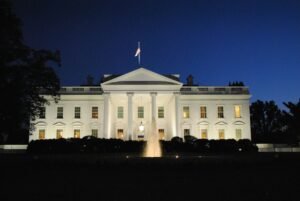
When Xi Jinping stood before the Charters of Freedom at the National Archives on Friday, the visual was unmistakable: the leader of the Chinese Communist Party, framed by the Constitution and Bill of Rights, projecting respect for the American founding document while his government simultaneously tightens authoritarian control at home and challenges the U.S.-led order abroad. The photo-op was the closing gesture of a three-day state visit that produced few concrete deliverables but one striking commitment — two more Xi-Trump summits before December.
The announcement, delivered by Xi himself in the East Room alongside President Trump, caught even seasoned China watchers off guard. “We will meet twice more this year,” Xi said, according to the official Chinese readout. Trump confirmed the schedule, telling reporters, “We have a very good relationship. We understand each other.” The White House later specified the next meetings would likely occur on the margins of the G20 summit in Johannesburg in November and a standalone summit in December, location undetermined. For a relationship that has operated largely through gritted teeth and competing tariff schedules since 2018, the cadence represents a dramatic recalibration.
What Happened: Symbolism Over Substance
The visit’s tangible outcomes were thin. No joint communiqué. No breakthrough on fentanyl precursor controls, despite the issue dominating Trump’s 2024 campaign rhetoric. No progress on the Phase One trade agreement’s unmet purchase commitments, which expired in December 2025 with China having bought roughly 58% of the pledged $200 billion in additional U.S. goods. The Treasury Department’s latest report, released quietly on Thursday, again declined to label China a currency manipulator — a designation Trump promised on day one but has now deferred four times.
What the visit did produce was a choreographed reset. Xi’s itinerary — a state dinner at the White House, a meeting with congressional leadership (notably excluding Speaker Mike Johnson, who declined to attend), a roundtable with U.S. CEOs including Apple’s Tim Cook and BlackRock’s Larry Fink, and the Archives visit — was designed to project normalcy. The CEO roundtable was particularly revealing: Xi personally assured executives that “China’s market will only open wider,” a pledge he has made at every major foreign engagement since Davos 2017, even as market access for foreign firms has contracted under the 2021 Data Security Law and 2023 revised Anti-Espionage Law.
Why It Matters: Beijing’s Bet on Personal Diplomacy
The decision to double down on leader-level diplomacy reflects a strategic calculation in Zhongnanhai. Chinese officials privately acknowledge that the structural drivers of competition — technology containment, Taiwan, the South China Sea, ideological divergence — are immutable under any U.S. administration. But they also believe Trump’s transactional instincts and aversion to multilateral frameworks create openings that a more systematic Democratic administration would not. “Trump cares about deals, not values,” a senior Chinese diplomat told me on condition of anonymity last month. “If we give him wins he can sell — agricultural purchases, investment announcements, fentanyl cooperation — he will resist the pressure from his own hawks to escalate.”
This theory was tested immediately. On Wednesday, the same day Xi arrived, the Commerce Department added 42 Chinese entities to the Entity List, including subsidiaries of SMIC and CJC, citing military end-use concerns. Beijing’s response was notably restrained: a Foreign Ministry statement expressing “strong dissatisfaction” but no retaliatory measures announced. The contrast with 2020, when China responded to similar moves with its own Unreliable Entity List and export controls on rare earths, was deliberate. Xi’s team has decided that preserving the summitry track outweighs responding to each provocation.
The risk is asymmetric. Trump’s domestic coalition includes China hawks — Rubio, Cotton, Gallagher — who view engagement as appeasement. His 2024 platform promised 60% tariffs on Chinese goods; the current effective rate sits at roughly 19% after selective exemptions for consumer electronics and industrial inputs. Every summit without concrete concessions increases the political cost for Trump. The December summit, occurring after the midterms, may be the last moment when Trump has maximum flexibility before the 2028 cycle consumes the bandwidth.
Historical Context: The Nixon-Mao Trap
There is precedent for this kind of leader-level bet. In 1972, Nixon’s visit to Beijing produced the Shanghai Communiqué — a masterpiece of strategic ambiguity that papered over Taiwan with the “acknowledge” formula and bought a decade of strategic cooperation against the Soviet Union. But the communiqué worked because both sides faced a shared existential threat. Today’s shared threats — climate, pandemics, financial stability — are real but lack the clarifying urgency of a nuclear-armed adversary.
A closer parallel may be the 2001-2008 period, when Jiang Zemin and Hu Jintao each invested heavily in personal chemistry with George W. Bush. The results were mixed: cooperation on North Korea and counterterrorism, but no progress on trade imbalances, human rights, or Taiwan arms sales. When the financial crisis hit in 2008, the relationship had no institutional ballast — only leader goodwill, which evaporated with the next administration. The Obama-Xi Sunnylands summit in 2013 attempted to replicate the format; it produced the HFC agreement and little else.
The difference now is that the institutional architecture has been deliberately dismantled. The Strategic and Economic Dialogue, the Cyber Working Group, the Law Enforcement Dialogue — all created between 2009 and 2015 — were allowed to lapse or were terminated by the first Trump administration. The Biden administration restored some channels but could not rebuild the trust. Xi’s bet is that Trump 2.0 will not rebuild them either, preferring direct leader-to-leader calls over bureaucratic processes. That may suit Beijing’s centralized system, but it leaves the relationship dangerously dependent on two men in their late 70s.
What to Watch: The Johannesburg and December Tests
Three indicators will reveal whether this diplomacy produces substance or merely theater. First, the fentanyl precursor issue. The DEA’s 2025 National Drug Threat Assessment identified 97% of precursor chemicals seized at the U.S. border as originating from China. Beijing pledged scheduling controls on 40 additional precursors in 2024; implementation has been spotty. If the November G20 bilateral yields a verifiable enforcement mechanism — not just a pledge — it signals Xi is willing to pay a domestic political price (alienating chemical industry interests) for the relationship.
Second, the Taiwan Strait. The PLA’s “Joint Sword-2025B” exercises in June simulated a blockade with unprecedented realism, including civilian vessel interdiction drills. The U.S. responded with a carrier group transit and accelerated delivery of Harpoon missiles to Taiwan. Neither side wants a crisis before the December summit, but the PLA’s training cycle does not pause for diplomacy. Watch for whether Xi offers a de-escalation gesture — a hotline restoration, a notification protocol — or whether the military track remains entirely compartmentalized.
Third, the CEO factor. The roundtable attendees represented $4.2 trillion in combined market cap. Their message to both governments was consistent: decoupling is impossible, but uncertainty is unsustainable. Cook’s presence was notable — Apple’s China revenue fell 13% in FY2025, and the company has moved 15% of iPhone production to India. If the December summit produces a “digital economy” working group with real market access commitments, it will be because corporate pressure forced specificity onto the vague “open wider” rhetoric.
Key Takeaway
Xi’s Archives visit was a masterclass in symbolic diplomacy — the General Secretary of the Communist Party paying homage to a document his system rejects, betting that the American president values the pageantry more than the principles. The two promised summits are Beijing’s insurance policy against a U.S. political system that swings wildly every four years. But personal chemistry is not a substitute for institutional guardrails, and the structural forces — semiconductor controls, alliance hardening in the Indo-Pacific, demographic collapse in China, fiscal unsustainability in the U.S. — will outlast both men. The question is not whether Xi and Trump can get along. It is whether the relationship they are building can survive the moment they leave the room.